




Is there a way you can make a "logarithmic gradient" in photoshop CS3 or any photoshop.

logarithmic gradient
Started by
.:SquEWHeeT:.
, Sep 30 2007 03:37 PM
7 replies to this topic
#1

.:SquEWHeeT:.
-
- Members
-

- 7 posts
Young Padawan
- Gender:Male
- Location:Illinois
Posted 30 September 2007 - 03:37 PM
#2
austen
-

- Members
-
- 910 posts
P2L Jedi
- Location:Montana, US
- Interests:Web design, snowboarding (lots of it), Computer science related.
Posted 30 September 2007 - 05:05 PM
I'm confused as to what you mean by "logarithmic" gradients... what would be the practicality of this?? maybe show an example or something?
-austen
-austen
#3
.:SquEWHeeT:.
-
- Members
-
- 7 posts
Young Padawan
- Gender:Male
- Location:Illinois
Posted 30 September 2007 - 09:33 PM
This a Linear Gardient: 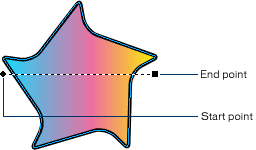
 Linear gradients have two handles and apply color in a straight, graduated transition in constant increments. The start point determines the location of one end of the gradient. The end point determines the location of the other end of the gradient and the gradient's angle.
This is a Logarithmic Gardient: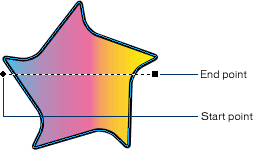
Logarithmic gradients have two handles. They apply color in a straight, graduated transition using increasingly wider bands. The start point determines the location of one end of the gradient. The end point determines the location of the other end of the gradient and the gradient's angle.
Linear gradients have two handles and apply color in a straight, graduated transition in constant increments. The start point determines the location of one end of the gradient. The end point determines the location of the other end of the gradient and the gradient's angle.This is a Logarithmic Gardient:
Logarithmic gradients have two handles. They apply color in a straight, graduated transition using increasingly wider bands. The start point determines the location of one end of the gradient. The end point determines the location of the other end of the gradient and the gradient's angle.
#4
austen
-
- Members
-
- 910 posts
P2L Jedi
- Location:Montana, US
- Interests:Web design, snowboarding (lots of it), Computer science related.
Posted 30 September 2007 - 10:01 PM
Ok, I understand the difference now... but as far as I know these don't exist as far as photoshop is concerned. Couldn't you play around with the gradient position sliders and achieve the same effect in the gradient editor? (The ones underneath the gradient color bar)
-austen
-austen
#5
Scythar
-

- Members
-
- 1,888 posts
Honored X Staff
- Gender:Male
- Location:Antwerp (Belgium)
Posted 02 October 2007 - 05:51 AM
(you dont have a begin and end point, but beginpoint is where you start dragging, and endpoint is well erm... where you end dragging)
open the gradient settings in photoshop and move the sliders manually from where you want the new color to begin and where you want it to end.
You have far more control this way.
I would put some screenshots, but i am at school, hope i wont forget when i get home, or tomorrow after noon...
open the gradient settings in photoshop and move the sliders manually from where you want the new color to begin and where you want it to end.
You have far more control this way.
I would put some screenshots, but i am at school, hope i wont forget when i get home, or tomorrow after noon...
#6
Scythar
-
- Members
-
- 1,888 posts
Honored X Staff
- Gender:Male
- Location:Antwerp (Belgium)
Posted 03 October 2007 - 07:05 AM
So, when you click your gradient tool:
 gradientTool.jpg 2.58KB
49 downloads
gradientTool.jpg 2.58KB
49 downloads
First of all, off course in your top settings toolbar, you can choose a gradient by clicking the arrow next to the gradient. The little arrow (upper right corner in the popup window) will take you to other gradient presets (if any).
SimpleGradient.jpg 54.79KB
90 downloads
when you've choosen your gradient, you can click/drag a selection to fill it with the gradient:
Drag_Gradient.jpg 42.61KB
104 downloads
Result:
ResultSimple.jpg 46.43KB
64 downloads
Off course, this part you allready knew i suppose.
Now, to change the existing gradient...
Click in the top toolbar on the gradient itself:
EditGradient.jpg 4.79KB
59 downloads
You will now see a window called the gradient editor (doh!).
GradientEditor.jpg 40.98KB
76 downloads
Here you'll see the same presets available AND at the bottom half, the editor
gradient name... no comment
gradient type: there are 2 types, mostly you'll need the "solid" option, for random colors you could use "noise" option, which basicly does the same thing as the noise filter, but as a gradient.
Now the fun part: the gradient preview bar (tip: if you want more control and thus want to make the bar longer, just make your window wider)
There are several things you can play with to completely mess up your gradient ( ):
):
the top part controls the opacity, the bottom part the colors.
Clicking between 2 colrstops or opacity stops creates another stop with a color of your liking (standard takes the forground color but you can change that at any moment) AND a midpoint. The transition between 2 colorstops is always smooth (when smoothness is set on 100% that is, but standard it is set on 100).
When you move the midpoint you can change the fastness of 1 color going into another color (this is what you mean with "logaritmic i suppose, but here theres far more control)
newcolorstop.jpg 15.9KB
77 downloads
newopacitystop.jpg 17.63KB
46 downloads
colorstopadjust.jpg 22.65KB
73 downloads
TIP: if you want a immediate, sudden colorchange: use 2 colorstops of same color for color 1 and 2 stops for color 2, and put the first stop of color 2 right on top (it snaps) of colorstop 2 from color 1.
Typical "metal" gradient would look something like this:
TypicalBrassGradient.jpg 19.85KB
73 downloads
Simple and Brass gradient results in next post:
If there are any questions, dont hesitate...
gradientTool.jpg 2.58KB
49 downloadsFirst of all, off course in your top settings toolbar, you can choose a gradient by clicking the arrow next to the gradient. The little arrow (upper right corner in the popup window) will take you to other gradient presets (if any).
SimpleGradient.jpg 54.79KB
90 downloadswhen you've choosen your gradient, you can click/drag a selection to fill it with the gradient:
Drag_Gradient.jpg 42.61KB
104 downloadsResult:
ResultSimple.jpg 46.43KB
64 downloadsOff course, this part you allready knew i suppose.
Now, to change the existing gradient...
Click in the top toolbar on the gradient itself:
EditGradient.jpg 4.79KB
59 downloadsYou will now see a window called the gradient editor (doh!).
GradientEditor.jpg 40.98KB
76 downloadsHere you'll see the same presets available AND at the bottom half, the editor
gradient name... no comment
gradient type: there are 2 types, mostly you'll need the "solid" option, for random colors you could use "noise" option, which basicly does the same thing as the noise filter, but as a gradient.
Now the fun part: the gradient preview bar (tip: if you want more control and thus want to make the bar longer, just make your window wider)
There are several things you can play with to completely mess up your gradient (
):the top part controls the opacity, the bottom part the colors.
Clicking between 2 colrstops or opacity stops creates another stop with a color of your liking (standard takes the forground color but you can change that at any moment) AND a midpoint. The transition between 2 colorstops is always smooth (when smoothness is set on 100% that is, but standard it is set on 100).
When you move the midpoint you can change the fastness of 1 color going into another color (this is what you mean with "logaritmic i suppose, but here theres far more control)
newcolorstop.jpg 15.9KB
77 downloads
newopacitystop.jpg 17.63KB
46 downloads
colorstopadjust.jpg 22.65KB
73 downloadsTIP: if you want a immediate, sudden colorchange: use 2 colorstops of same color for color 1 and 2 stops for color 2, and put the first stop of color 2 right on top (it snaps) of colorstop 2 from color 1.
Typical "metal" gradient would look something like this:
TypicalBrassGradient.jpg 19.85KB
73 downloadsSimple and Brass gradient results in next post:
If there are any questions, dont hesitate...
#7
Scythar
-
- Members
-
- 1,888 posts
Honored X Staff
- Gender:Male
- Location:Antwerp (Belgium)
Posted 03 October 2007 - 07:13 AM
Forgot: to change the color of a colorstop, doubleclick on the colorstop:
adjustcolorinstop.jpg 17.14KB
87 downloads
You can see when a colorstop is active, because the triangle is black, not white AND you see the midpoints.
Result simple gradient (added bevel and shadow for little extra punch):
ResultSimple.jpg 46.43KB
37 downloads
Result Metal gradient:
EndResult.jpg 40.44KB
61 downloads
Hope this has helped anyone a little, but off course after this introduction, you can ask more specific questions on the topic...
adjustcolorinstop.jpg 17.14KB
87 downloadsYou can see when a colorstop is active, because the triangle is black, not white AND you see the midpoints.
Result simple gradient (added bevel and shadow for little extra punch):
ResultSimple.jpg 46.43KB
37 downloadsResult Metal gradient:
EndResult.jpg 40.44KB
61 downloadsHope this has helped anyone a little, but off course after this introduction, you can ask more specific questions on the topic...
#8
Lastcrime
-

- Members
-
- 649 posts
Impatient Jedi that likes to eat cereal
- Gender:Male
- Location:Toronto, Ontario, Canada
- Interests:Soccer, Snowboarding, Hockey, B-ball, Skateboarding, Computers!
Posted 03 October 2007 - 10:36 AM
yah when you edit the gradient you have to change the width between the colours to get larger and smaller bars.


0 user(s) are reading this topic
0 members, 0 guests, 0 anonymous users

